Autonomous coding agents have fundamentally inverted the economics of software creation: the marginal cost of producing code has plummeted toward zero, while the cost of verifying correctness, catching subtle invariants, and maintaining architectural coherence has become the defining bottleneck of modern engineering teams.
“Vibe Coding” — prompting vaguely in natural language and blindly accepting thousand-line diffs without reading them — works fine for weekend prototypes, yet collapses rapidly when confronted with concurrency race conditions, cryptographic edge cases, or subtle state corruption. Production AI-Native engineering demands a disciplined counterbalance: Spec-Driven Development anchored by Deterministic Verifiers.
1. Pairing Stochastic Generators with Deterministic Oracles
Mathematically, every Large Language Model is a probabilistic token sampler (P(next_token | context)). That stochastic nature gives coding agents remarkable synthesis capabilities across APIs and domains, yet guarantees they can never serve as their own ground-truth soundness proof.
By contrast, static type checkers, SMT solvers, architectural AST linters, and property-based fuzzers are deterministic verification functions (Verify(Code, Spec) → Pass | Counterexample).
┌───────────────────────────────────────────────────────────────────────────┐
│              EXECUTABLE SPECIFICATION (Single Source of Truth)            │
│     • Domain Invariants & State Transition Contracts                      │
│     • Algebraic Type Signatures & Non-Functional Security Bounds          │
└───────────────────┬───────────────────────────────────────┬───────────────┘
                    │ Guides Synthesis                      │ Compiles Oracles
                    ▼                                       ▼
      ┌───────────────────────────┐           ┌───────────────────────────┐
      │   STOCHASTIC GENERATOR    │ Candidate │  DETERMINISTIC VERIFIER   │
      │    (AI Coding Agents)     │ ───────>  │ • Strict Type Compiler    │
      │  High Throughput • Broad  │           │ • Property-Based Fuzzer   │
      │                           │ <───────  │ • Architecture AST Linter │
      └───────────────────────────┘  Exact    └─────────────┬─────────────┘
                                     Counterexample         │ 100% Green Gate
                                                            ▼
                                              [ Ready for Human Diff Review ]
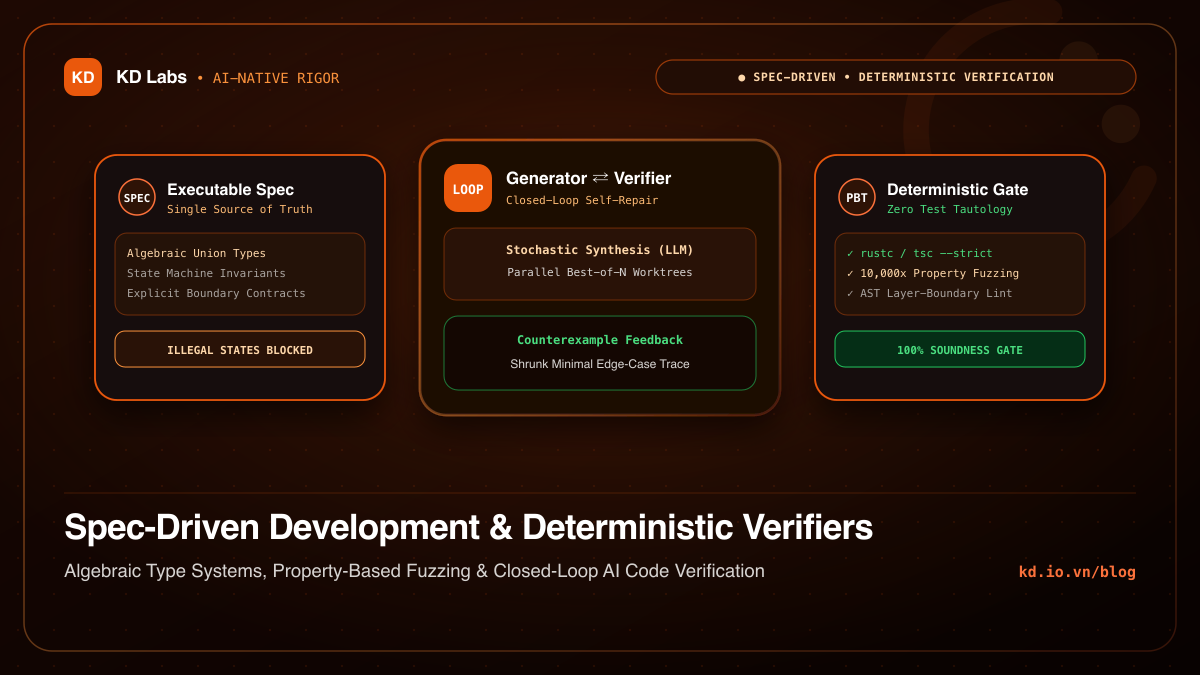
Coupling both halves into a closed Generator–Verifier Loop transforms agent reliability: whenever an invariant breaks, the deterministic oracle emits a concrete, reproducible counterexample that guides the agent to self-repair before a human engineer ever reviews the diff.
2. Making Illegal States Unrepresentable via Type Systems
For an autonomous coding agent, strict static type systems like Rust or TypeScript (strict: true) are not bureaucratic overhead — they are sub-second, zero-token feedback rails.
Instead of writing fragile prose guidelines warning an agent “Never read the decryption key while the vault is locked”, AI-Native architects encode state invariants directly into Algebraic Data Types (Discriminated Unions):
// FRAGILE: Loose optional fields allow agents to touch masterKey while locked
interface WeakVaultState {
  isLocked: boolean;
  masterKey?: CryptoKey;
  entries?: EncryptedEntry[];
}

// AI-NATIVE: Illegal states cannot compile!
export type VaultState =
  | { readonly status: 'locked'; readonly salt: Uint8Array }
  | { readonly status: 'unlocked'; readonly masterKey: CryptoKey; readonly entries: ReadonlyArray<EncryptedEntry> };
With discriminated unions, any hallucinated attempt to read vault.masterKey outside a narrowed vault.status === 'unlocked' branch is caught instantaneously by the compiler.
3. Escaping the “Test Tautology Trap” with Property-Based Testing
When the same LLM run writes both an implementation function and its accompanying unit tests, teams routinely fall victim to Test Tautology: if the model misunderstands an edge case in the implementation (such as leap-second boundaries or multi-byte UTF-8 surrogate pairs), it encodes the exact same blind spot into its three hardcoded unit-test assertions. Every test passes green — until production traffic hits!
AI-Native engineering defeats tautological unit tests with Property-Based Testing (PBT) using frameworks like fast-check (TypeScript), proptest (Rust), or Hypothesis (Python):
- Example-Based Unit Tests: Check a handful of hand-picked inputs (
encode("hello")→decode(...) === "hello"). - Property-Based Tests: Declare universal invariants that must hold across all valid inputs, letting the test runner generate thousands of adversarial edge cases (empty buffers, zero bytes, boundary integers, malformed Unicode) and automatically shrink failures down to the minimal counterexample.
import fc from 'fast-check';
import { encryptPayload, decryptPayload } from './crypto-engine';

// Universal Invariant: Encrypt -> Decrypt must be a lossless identity for any byte array
test('AES-256-GCM roundtrip preserves arbitrary binary payloads', async () => {
  await fc.assert(
    fc.asyncProperty(
      fc.uint8Array({ minLength: 0, maxLength: 65536 }),
      fc.uint8Array({ minLength: 32, maxLength: 32 }),
      async (plaintext, rawKey) => {
        const sealed = await encryptPayload(plaintext, rawKey);
        const opened = await decryptPayload(sealed, rawKey);
        expect(opened).toEqual(plaintext);
      }
    ),
    { numRuns: 1000 }
  );
});
4. The Four-Stage Spec-Driven Workflow at KD Labs
Across our engineering workflows at KD Labs, human-agent collaboration follows a structured four-stage lifecycle rather than unstructured chat prompting:
- Author the Executable Specification (
SPEC.md): Articulate explicit state transitions, input/output schemas, security boundaries, and explicit non-goals before touching implementation code. - Lock Interfaces & Deterministic Harnesses First: Commit strict type signatures, AST import-boundary lint rules, and property-based test suites as immovable guardrails.
- Parallel Best-of-N Synthesis: Dispatch the specification across multiple agents simultaneously using Compare (Best-of-N) mode in KD Code, where each agent iterates inside its own isolated Git worktree.
- Deterministic Gating & Human Architectural Review: Filter candidates strictly through
typecheck + lint + property-tests + build, then inspect side-by-side diffs to merge the cleanest, most maintainable implementation.
In the AI-Native era, software engineering rigor matters more than ever. Elevating engineers from manual syntax typists to specification architects and deterministic verifier designers is how teams ship fast without breaking trust.